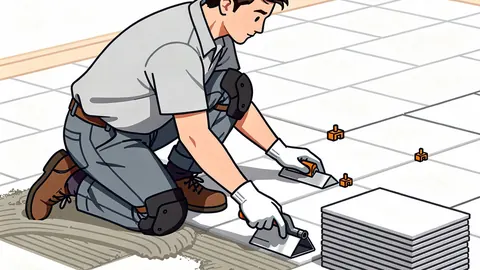
Laying a tile seems like a simple process at first glance - apply glue, lay the tile. However, there are many nuances in practice. Even one mistake is enough for the tiles to crack, crack, or water leak in a few months and the work has to start all over again.
Here we've rounded up 10 of the most common mistakes and offer expert advice on how to avoid them.
1. Improper preparation of the surface
You cannot build a strong house on a weak foundation. Likewise, tiles cannot be laid on dusty, damp or uneven floors.
- Mistake: Laying tiles on a dusty, damp or uneven floor (so-called "styashka").
- The result: the glue sticks to the dust, not the floor. Over time, the tile "squeaks" (makes a hollow sound) and shifts.
- Solution: the surface must be perfectly clean, dry and leveled. Be sure to use a primer to bind the dust. If the floor is uneven, use a self-leveling floor compound first.
2. Ignoring grooves (laying tiles without work)
Some owners want a "uniform" (continuous) look and request that the tiles be laid without gaps.
- Mistake: Laying the tiles with "glue", without getting it, hoping for better visuals.
- Result: the building and the slab itself "breathe" (expands/narrows) with the temperature change. Due to the lack of space, the tiles push against each other and crack or crack.
- Solution: leave at least 2-3 mm gap. This is necessary for thermal expansion. A quality fugue will show these lines beautifully in the interior.
3. Choosing the wrong glue-cement
Not all glues are the same. Glue designed for small ceramic wall tiles cannot withstand heavy ceramic granite floor tiles.
- Mistake: Using cheap, "universal" glue for large-sized or ceramic granite tiles.
- Solution: Ceramogranite is heavy and does not absorb water, so it needs a reinforced, elastic adhesive. For large format use class C2TE S1 (for example MAPEI Keraflex Maxi S1).
4. Uneven application of glue ("sticks")
- Mistake: applying glue in spots, "spots" in the corners of the tile.
- Result: a void remains under the tile. If a heavy object falls on this place or you step on it with your heel, the tile will definitely break.
- Solution: use a toothed spatula (called "Grebenka") and apply the glue in even lines. For large tiles, use the "back-buttering" method — apply glue to both the floor and the back of the tile.
5. Immersion of tiles in water
- Mistake: soaking modern tiles in water.
- Reality: This method was necessary for Soviet-era clay tiles. Modern tiles and adhesives do not require this. On the contrary, excess moisture inhibits the action of the glue.
- Solution: Lay dry. Clean the back of the tiles with a damp sponge only if they are dusty, but never wet.
6. Alignment "by eye".
- Error: working without level and laser.
- Result: When you reach the center of the room, the lines will be slanted and the pattern will shift.
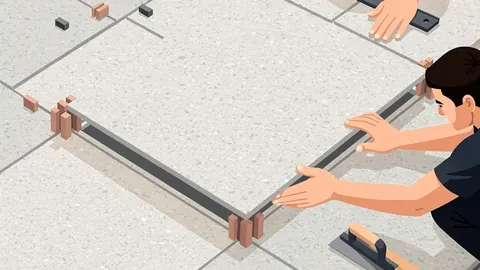
- Solution: Use a laser for straight lines and be sure to use a tile leveling system (called clips and wedges). This system perfectly aligns the tiles in relation to each other and eliminates the appearance of "teeth".
7. Ignoring the fugue quality
- Mistake: Using cheap putty in wet spots.
- Result: water gets under the tile, mold and fungus appear.
- Solution: Use a hydrophobic (water-resistant) and anti-fungal fugue (eg: MAPEI Ultracolor Plus).
8. Acceleration of work
- Mistake: Walking on a wet floor.
- Result: stepping on a newly laid tile breaks its level and distorts the surface. And premature grouting "locks" moisture under the tile, which can cause yellowing of the grout or the appearance of spots.
- Solution: Wait at least 24 hours after laying the tile before grouting. Premature running will level the engine.
9. Poor quality tools
- Mistake: Walking on a wet floor.
- Solution: Wait at least 24 hours after laying the tile before grouting. Premature running will level the engine.
10. Working without a professional
- Mistake: performing complex work (for example: large-format tiles or "Christmas tree" arrangement) without prior experience.
- Solution: Laying tiles requires practical skills and a steady hand. If you're not sure, hire a professional. Alternatively, you can invite the handyman as a consultant only, so that he can start the layout, and then you can continue with his instructions. In the end, this will save you money.
Frequently Asked Questions (FAQ)
What size notched trowel should I use for 60x60 cm tiles? - Use a notched spatula of at least 10mm or 12mm. Also, it is recommended to use the "double application" method (apply a thin layer of glue to the back of the tile as well) so that the glue completely covers the surface.
Can a new tile be laid over an old tile? - Yes, but only if the old tiles sit firmly and do not shake. Be sure to use a special primer (for example, quartz primer or "concrete contact") and high-quality elastic glue.
Why did the fugue crack? - Cracking of the putty mainly occurs when the glue under it was not completely dry during the putty, or you got too much water in the putty mixture. Also, this can happen if the sub-floor (black floor) moves.